
Home · Ancient History · Ancient Egypt · Early Dynastic Period
Narmer
Narmer is usually counted as the first king of the First Dynasty. The chronology used on this site dates his reign to around 2900 BCE, while radiocarbon dating and some other chronologies place it nearer 3100 BCE. Seal impressions from the royal cemetery at Abydos put his name at the head of the list of kings, and his famous palette shows him wearing the crowns of both Upper and Lower Egypt. Many Egyptologists identify him with Menes, the founder of Egypt in later tradition, but the question is still open.
- Reign
- c. 2900 BCE (c. 3100 BCE by other estimates), length unknown
- Dynasty
- 1st (some scholars place him at the end of "Dynasty 0")
- Predecessor
- Probably Ka
- Successor
- Hor-Aha
- Queen
- Possibly Neithhotep
- Burial
- Tombs B17 and B18, Umm el-Qa'ab, Abydos
- Names
- Horus name Narmer, written with a catfish (nar) and a chisel (mer), its meaning uncertain. If he is the Menes of later tradition: Meni in the Abydos and Turin king lists, Menes in Manetho
- Main sources
- The Narmer Palette, the Narmer Macehead, seals and jar inscriptions
Path to the throne
THEME ONE
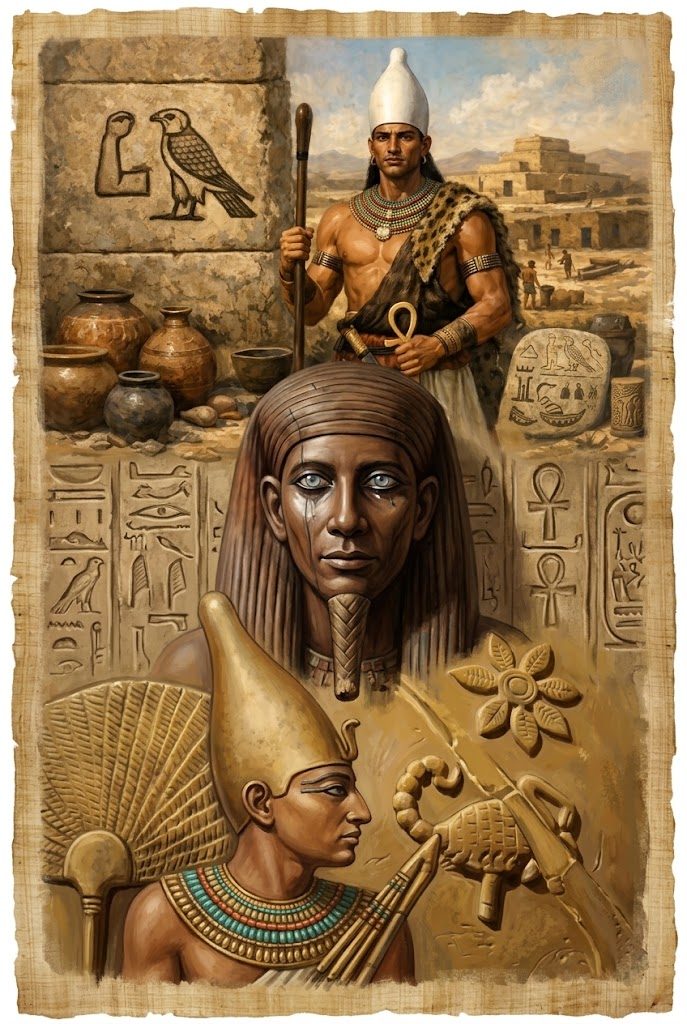
Before Narmer, much of Upper Egypt was already ruled by a line of kings buried at Abydos, whom modern scholars call "Dynasty 0". Some of their names, such as Iry-Hor and Ka, survive in short inscriptions on jars and seal impressions, and Egypt was probably already partly united under them. Narmer seems to have completed the process, perhaps by conquering the last independent power in the north-western Delta. Nothing certain is known about his parents or how he came to the throne.
Reign and government
THEME TWO
No text describes how Narmer governed: his age left labels, seals and ceremonial objects, not chronicles. They still show the tools of a new state. His name is written inside a serekh - a frame in the shape of a palace facade, topped by the falcon of Horus - on jars, seals and labels from Abydos to the Delta, and sealed jars of produce suggest an administration that collected and recorded goods across the country. In all, his name is known from nearly a hundred inscriptions at 26 sites.
Years were not numbered but named after a major event. A small label that Günter Dreyer found at Abydos in 1993 names a year of Narmer after the same victory that appears on his palette.
Wars and foreign lands
THEME THREE
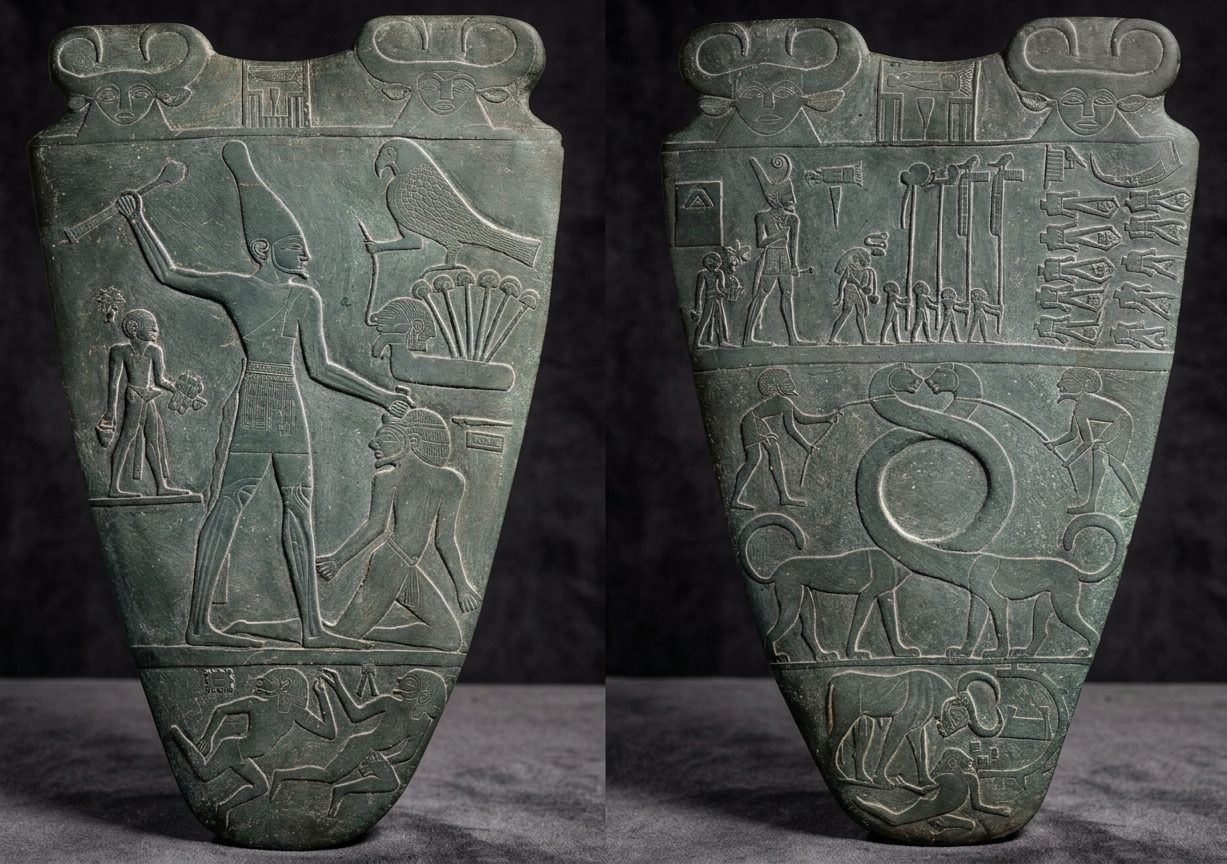
The Narmer Palette and the Narmer Macehead show the king as a conqueror. He raises a mace over a kneeling enemy, inspects rows of beheaded captives and receives prisoners and livestock: the macehead lists 120,000 captives, 400,000 cattle and 1,422,000 goats. Whether these scenes record real campaigns or a standard image of royal power is debated.
Beyond Egypt, about twenty pottery fragments bearing his serekh, some of them uncertain, have been found in the southern Levant, at sites such as Tel Arad, Nahal Tillah and Tel Erani. Egyptian presence there reached its peak in his reign, though whether it meant trade, settlers or soldiers is still discussed.
Monuments and art
THEME FOUR
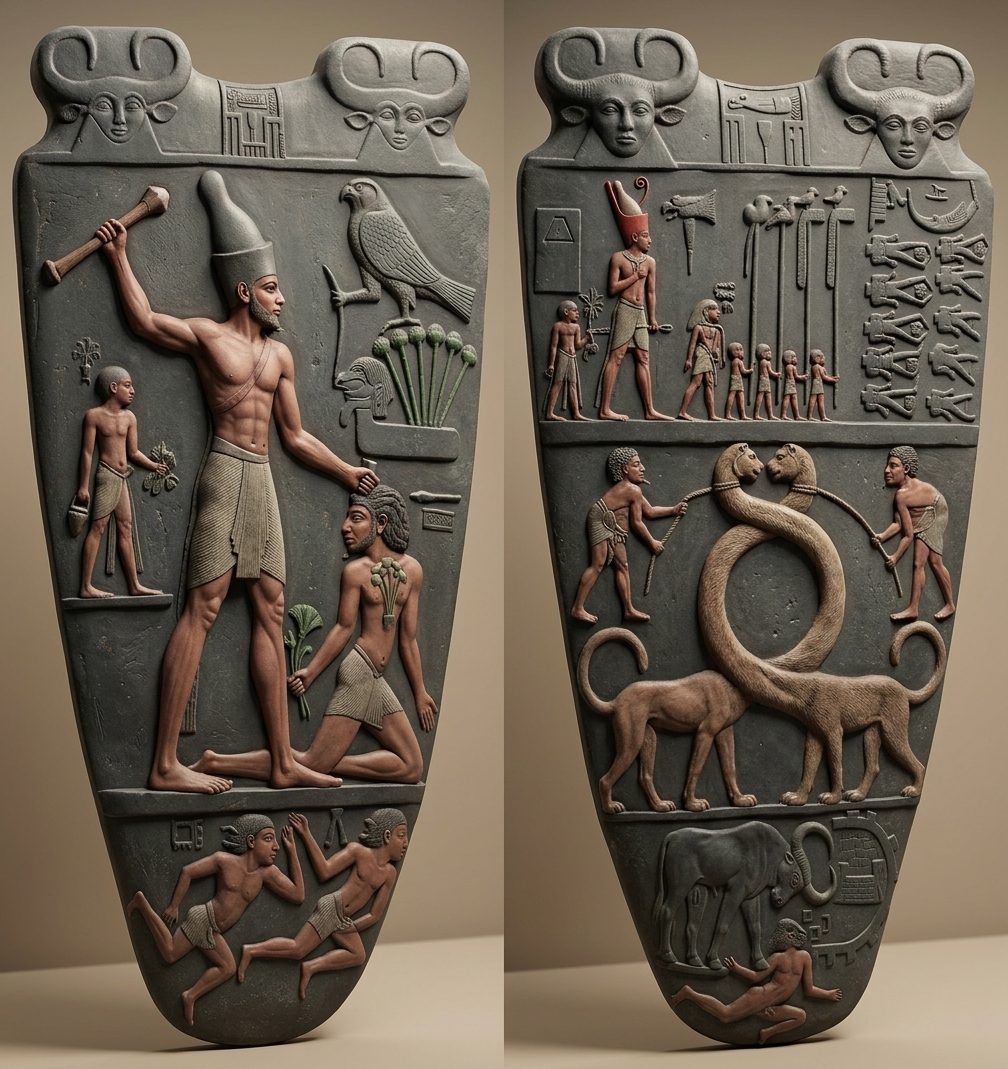
The Narmer Palette is a shield-shaped slab of siltstone about 64 cm tall. James Quibell and Frederick Green found it in 1897–98 in the temple of Horus at Hierakonpolis (Nekhen). It is a ceremonial version of the stone palettes used for grinding eye paint: the round hollow in the middle is framed by the long, intertwined necks of two "serpopards". On one side the king wears the tall White Crown of Upper Egypt, on the other the Red Crown of Lower Egypt.
The palette already follows rules that Egyptian art would keep for three thousand years: the king is the largest figure, scenes are laid out in horizontal bands, and bodies combine profile and frontal views. It is kept in the Egyptian Museum in Cairo, and the macehead, also from Hierakonpolis, is in the Ashmolean Museum in Oxford.
Religion and beliefs
THEME FIVE
Kingship itself was religious. Narmer's name sits in the serekh beneath the falcon of Horus, because the king was seen as Horus on earth. At the top of both sides of the palette, heads of a cow goddess with a human face, usually identified as Bat, look down on the scene. Above the defeated enemy, a falcon holds a rope tied to a human head that rises from papyrus plants - usually read as the god delivering the land of the papyrus, the Delta, into the king's hands. The palette was not for everyday use: it was most likely a gift to the temple of Hierakonpolis, one of the oldest centres of the cult of Horus.
Death and legacy
THEME SIX
Narmer was buried at Umm el-Qa'ab near Abydos, in a modest tomb of two joined mud-brick chambers, B17 and B18, covering about 31 square metres, while the tomb of his successor Hor-Aha is more than three times larger. Two seal impressions from the same cemetery, made in the reigns of Den and Qa'a, list the kings of the First Dynasty in order, and both begin with Narmer, followed by Hor-Aha.
Queen Neithhotep, whose great tomb at Naqada carries the names of Narmer and Hor-Aha, may have been his wife, although some scholars place her a generation later. Later Egyptians remembered the founder of their state as Menes: Herodotus says he founded Memphis, and Manetho that he was killed by a hippopotamus. Whether Menes was Narmer or Hor-Aha is still debated.
Key dates
- Before ~2900 BCEKings of "Dynasty 0", among them Iry-Hor and Ka, are buried at Abydos.
- ~2900 BCENarmer completes the unification of Egypt, and the First Dynasty begins.
- ~2900 BCEEgyptian presence in the southern Levant reaches its peak.
- 1897–98James Quibell and Frederick Green find the Narmer Palette at Hierakonpolis.
- 1964Werner Kaiser identifies tombs B17 and B18 at Abydos as Narmer's.
- 1985A seal impression from the reign of Den, listing Narmer first, is found at Abydos.
- 1991A seal impression from the reign of Qa'a lists all eight kings of the First Dynasty, from Narmer to Qa'a.
- 1993Günter Dreyer finds a year label of Narmer at Abydos showing the same event as the palette.